
Few moments in golf are as dramatic as a playoff at Augusta. When two or more players finish tied after 72 holes, everything comes down to a high-pressure showdown that tests skill, nerves, and precision. But who actually wins under these rules, and how is the champion decided? In this guide, we’ll break down exactly
Few moments in golf are as dramatic as a playoff at Augusta. When two or more players finish tied after 72 holes, everything comes down to a high-pressure showdown that tests skill, nerves, and precision. But who actually wins under these rules, and how is the champion decided?
In this guide, we’ll break down exactly how the process works, what determines the winner, and why this format creates some of the most unforgettable moments in golf history.
Understanding the Masters Playoff Format
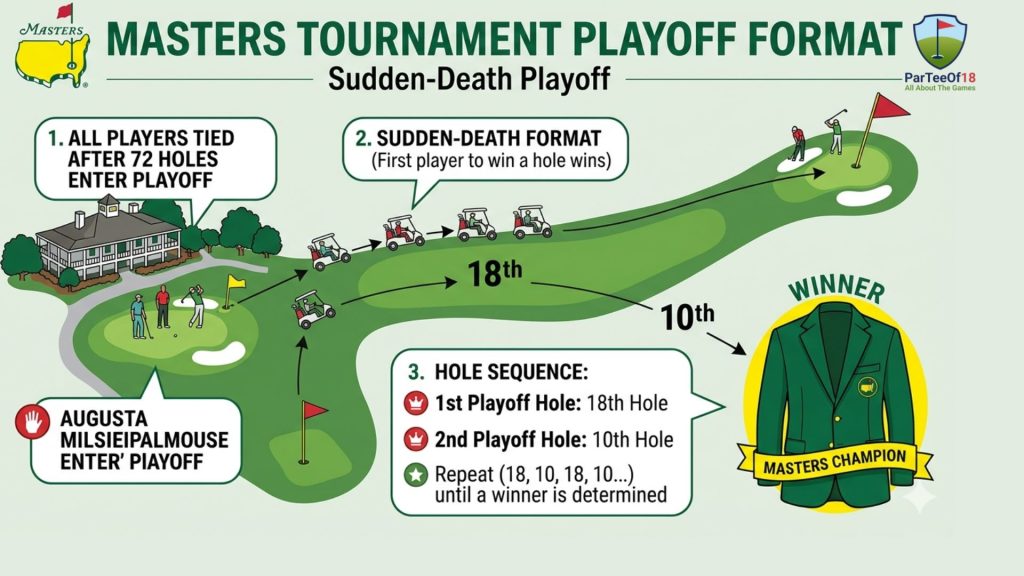
The masters playoff format is designed to produce a clear winner immediately after a tie. Unlike some tournaments that use aggregate scoring over multiple holes, this format follows a sudden-death system.
That means players compete hole-by-hole, and the first golfer to score lower than the others on a hole wins the tournament instantly. There’s no second chance once a player loses a hole in this scenario.
This structure adds intensity because every shot could end the tournament.
How the Playoff Begins?
Once regulation play ends and players are tied for the lead, they don’t wait until the next day. Instead, the playoff begins shortly after the final round concludes.
The tied players return to the course and start the playoff on a designated hole. At Augusta National, the playoff typically begins on the 18th hole, one of the most iconic finishing holes in golf.
If no winner is decided there, the players move to the next predetermined hole and continue rotating until someone wins.

What Determines the Winner?
Winning under this format is straightforward in theory but incredibly challenging in practice.
Here’s how a winner is decided:
- All tied players play the same hole.
- Each player completes the hole.
- Scores are compared.
- The player with the lowest score on that hole wins immediately.
If two or more players are still tied after that hole, they move on to the next one and repeat the process.
This continues until a single player emerges with a better score than the others.
Why Sudden Death Is So Intense
Sudden death is one of the most pressure-packed formats in sports. There’s no room for recovery or long-term strategy every swing matters.
A single mistake, like a missed putt or a poorly placed drive, can end a player’s chances instantly. On the flip side, one brilliant shot can secure victory.
This is where preparation and mental strength come into play. Many players rely on tools like a golf scoring app to analyze their past rounds, track performance trends, and improve decision-making under pressure.
The Role of Course Knowledge
Augusta National is not just any course it’s one of the most challenging and strategic layouts in golf.
Players who perform well in playoffs often have:
- Strong knowledge of green speeds
- Experience with tricky pin positions
- Confidence in high-pressure situations
Because the playoff holes are usually familiar finishing holes, players must rely on both skill and memory to execute the perfect shot.
Famous Playoff Moments
Over the years, playoffs at the Masters have delivered unforgettable drama. Legendary players have won titles with clutch performances, while others have seen victory slip away in seconds.
These moments highlight exactly why the format is so compelling:
- A single birdie can seal a championship
- A missed short putt can cost everything
- Momentum can shift instantly
This unpredictability is what makes the playoff one of the most exciting finishes in all of sports.
Strategy in a Masters Playoff
Even though sudden death seems simple, there’s still strategy involved.
Players must decide:
- Whether to play aggressively or safely
- How to approach risk-reward shots
- When to attack the pin or aim for the center of the green
The right decision often depends on what competitors are doing. If another player hits an incredible shot, it may force others to take more risks.
Many golfers study these scenarios using a golf scoring app, which helps them simulate pressure situations and refine their strategies before stepping onto the course.
Mental Toughness: The Deciding Factor
At this level, every player has elite technical skills. What often separates the winner from the rest is mental strength.
In a playoff:
- There’s no time to recover from mistakes
- The crowd adds extra pressure
- Every decision is magnified
The ability to stay calm, focused, and confident can make all the difference.
Players who can control their nerves and trust their instincts are far more likely to come out on top.
How Long Can a Playoff Last?
There’s no fixed number of holes in a sudden-death playoff. It continues until a winner is determined.
Some playoffs end quickly on the very first hole. Others can stretch across multiple holes, increasing tension with each round.
The longer it goes, the more physically and mentally demanding it becomes.
Why This Format Is Unique?
Compared to other major tournaments, this format stands out because of its immediacy.
Other tournaments may use:
- Total score over multiple playoff holes
- Full additional rounds
But here, everything is decided in real time, right in front of the audience. This creates a dramatic, edge-of-your-seat experience that’s hard to match.
Final Thoughts
So, who wins under these rules? The answer is simple: the player who delivers the best score on a playoff hole at the right moment.
But behind that simple answer lies a complex mix of skill, strategy, and mental strength. The masters playoff format ensures that the champion is not just talented, but also resilient under extreme pressure.
It’s this combination that makes playoff victories at Augusta so special and so memorable.
FAQs
1.What happens if players remain tied after one playoff hole?
They continue to the next hole and repeat the process until a winner is determined.
2.How many players can be in a playoff?
Any number of players tied for the lead can compete in the playoff.
3.Is the playoff always sudden death?
Yes, the Masters uses a sudden-death format to decide the winner.
4.Which hole is used first in the playoff?
The playoff usually starts on the 18th hole at Augusta National.
5.Can the playoff last many holes?
Yes, it continues as long as needed until one player wins a hole outright.