
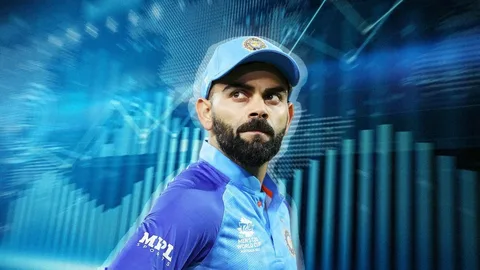
Cricket has seen many exceptional players who achieved great success. However, only a rare few completely redefine the standards by which everyone else is measured. Born in Delhi on November 5, 1988, Virat Kohli belongs to this elite category. He made his Test debut at the age of 21 and spent the next fifteen years
Cricket has seen many exceptional players who achieved great success. However, only a rare few completely redefine the standards by which everyone else is measured. Born in Delhi on November 5, 1988, Virat Kohli belongs to this elite category.
He made his Test debut at the age of 21 and spent the next fifteen years systematically dismantling batting records across all three formats. By 2026, his numbers stand as a towering monument to consistency—presenting statistical models with a level of dominance that traditional metrics still struggle to fully contextualize.
This deep dive examines the granular data behind Kohli’s career. We will explore his historical patterns, his unmatched peaks, the post-2019 drought, and his triumphant resurgence. Additionally, we will look at how modern analytical tools and platforms like 11xplay black help a new generation of cricket fans analyze elite athletic performance with unparalleled sophistication.
Early Career
Scouts and analysts frequently point to Kohli’s captaincy during India’s victorious 2008 U-19 World Cup campaign as the moment his unique talent became obvious. However, the raw numbers from that tournament told only a fraction of the story.
His initial ODI debut in August 2008 started modestly, and he recorded his first fifty-plus score in his third match.
Furthermore, he demonstrated a natural tendency to accelerate scoring in the crucial 35–45 over window. This specific tactical progression was an area where other top-order batsmen of that generation routinely struggled.
By 2012, Kohli had firmly established himself as India’s premier ODI batsman. By 2014, his career faced a massive hurdle during a brutal tour of England, where swinging deliveries repeatedly exposed his technique.
Rather than letting the failure define him, he became a dedicated student of technical reinvention. Comparing video footage of Kohli’s guard and head positions between 2014 and 2015 offers a true masterclass in conscious physical adjustment. Today, modern sports analytics platforms track these subtle biomechanical shifts as routine metrics.
The Peak Years
The spectacular four-year stretch from 2016 to 2019 produced statistical outputs that exist in an entirely separate dimension. In Test cricket alone, Kohli averaged over 65 during this specific window. This represents a sustained level of performance that only Sir Don Bradman had meaningfully exceeded in the modern era among players with more than 50 Test innings.
His 2016 home Test series against England featured three brilliant centuries. Meanwhile, his 2019 Indian Premier League (IPL) campaign for the Royal Challengers Bangalore (RCB) produced an explosive strike rate above 145.
Throughout this entire multi-year run, his ODI batting average hovered remarkably close to 70.
Fantasy sports enthusiasts utilizing platforms like 11xplay online to track Kohli’s performance during this golden era enjoyed a massive competitive edge. This advantage came not just from his raw run production, but from his supreme predictability.
His baseline performance floor was significantly higher than most players’ absolute ceiling, making him one of the safest high-scoring choices in fantasy cricket history.
The Form Slump and About Elite Athletes
From late 2019 through mid-2022, Kohli experienced a highly public and incredibly prolonged lean period. His Test century drought lasted over three calendar years, sparking immense media speculation. Public commentary ranged from technical critiques—such as an over-reliance on the on-side and a vulnerability to the fourth-stump line—to deep psychological analysis.
However, sports data analysts observed a much more nuanced story hiding beneath the surface. His fundamental shot selection had fundamentally changed.
His boundary percentage dropped significantly, and his run-per-ball rate in the critical 5–20 over window in ODIs slowed noticeably.
For fantasy managers and analysts tracking these micro-statistics on advanced data platforms, the numbers painted a clear picture. This was not a sudden loss of talent, but rather a temporary crisis of freedom. An athlete who had conquered the world through pure aggression was suddenly playing with caution, and elite batters rarely thrive when they become tentative.
Resurgence and Its Analytical Underpinnings
Kohli’s magnificent century against Afghanistan in the 2022 Asia Cup T20 officially broke his long international drought. While the century grabbed headlines, the real story lay in the analytical data leading up to that moment.
His classic straight drive had returned to form. His wrist positioning through the off-side perfectly matched the flawless geometry of his 2018 peak.
Furthermore, his statistical wagon wheel displayed a perfectly balanced distribution of boundaries across all sides of the ground—a metric that had been entirely missing from his data for three consecutive seasons. By rotating Kohli back into their primary captaincy options early in his resurgence, they secured significantly higher points than mainstream fans who waited for traditional media outlets to confirm his return to form.
This scenario serves as a perfect example of why granular statistical analysis matters. The public narrative only caught up to the reality six weeks after the data made it visible to anyone who was paying attention.
Kohli in T20 Internationals
When T20 international cricket first exploded onto the global scene, conventional wisdom dictated that the format belonged exclusively to brute power hitters. Kohli single-handedly disproved this theory. He proved that intelligent accumulation—running hard between wickets, consistently rotating strike, and methodically building an innings—could be equally or even more valuable.
His iconic performance during the 2022 T20 World Cup in Australia stands as a testament to this philosophy. He single-handedly guided India to victory against Pakistan with a breathtaking, 53-ball 82 not out.
This performance showcased an elite ability to read and dissect a high-pressure match situation before it even unfolded. As his career progressed into 2026, his T20 role naturally evolved more into a steady anchor than an outright aggressor.
Even with this shift, his statistical value to fantasy managers on platforms like Skyexchange and 11xplay online remains remarkably high because his ability to deliver under intense pressure is a proven statistical fact.
The IPL Legacy
Kohli’s long IPL career with the Royal Challengers Bangalore is entirely inseparable from his broader sporting legacy. Despite RCB’s historical struggles to convert regular-season brilliance into championship trophies, Kohli’s individual numbers across nearly two decades remain completely extraordinary.
His legendary 2016 IPL season is widely considered the greatest individual batting campaign in the tournament’s history. He amassed an astonishing 973 runs at an average of 81 and a blistering strike rate of 152.
To put this achievement into perspective, no other batsman has ever come within 200 runs of that magnificent single-season tally.
For serious fantasy cricket participants, Kohli’s IPL data is studied with absolute precision. His historical performance records at specific venues, his strike rate against pace versus spin, and his scoring consistency in the powerplay versus the death overs are all highly trackable data points. Managers consistently integrate these metrics into their nightly selection strategies.
What Kohli’s Career Tells Us About Peak Athletic Performance
Beyond the pure numbers, Kohli’s journey offers a fascinating case study in the psychology of sustained athletic excellence. His legendary dedication to physical fitness completely revolutionized the sport.
He completely transformed his diet and conditioning routines between 2012 and 2014, maintaining those elite standards ever since. This shift fundamentally altered the global conversation regarding the cricket lifestyle.
He proved to the world that cricket demands the exact same physical seriousness, endurance, and athletic commitment as professional football or track and field. Young cricketers training in 2026 approach their fitness with an intensity that simply was not standard in 2010.
This cultural shift is a direct, measurable result of the “Kohli effect.” Modern sports platforms recognize this by pairing detailed player biographies alongside raw statistics. When fans understand the immense dedication behind the numbers—the grueling gym sessions, the endless technical corrections, and the mental conditioning—they build a much deeper connection to the sport.
Frequently Asked Questions
What is Virat Kohli’s highest individual Test score?
Kohli’s highest Test score is an unbeaten 254 not out, which he scored against South Africa in Pune in 2019. This monumental performance is widely regarded as one of the finest displays of batting in modern Test history.
How many ODI centuries has Virat Kohli scored?
Virat Kohli has scored over 50 ODI centuries, making him the highest century-maker in the history of One Day International cricket. He achieved this incredible milestone by surpassing the legendary record previously held by Sachin Tendulkar.
Why was Kohli’s form analyzed with such scrutiny during his lean phase?
Because of his status as an all-time great, any extended drop in his performance naturally invites intense global analysis. Additionally, advanced tracking platforms showed highly specific, subtle changes in his shot selection and boundary percentages that made his decline an incredibly interesting case study for data analysts.
How do modern fantasy sports platforms utilize player biographies?
Detailed player narratives provide crucial context that raw numbers alone cannot explain. They help users understand why a player’s form might be shifting, what specific technical adjustments they have recently implemented, and how they historically perform in high-pressure match situations. This deeper context allows users to make significantly sharper, data-driven fantasy decisions.
Conclusion
Virat Kohli’s historic career is an incredible gift to cricket purists, data analysts, and everyday fans who love stories of human perseverance. His statistical footprint provides a narrative of peerless consistency, technical adaptation, mental struggles, and ultimate resurgence that a simple headline can never fully capture.
Platforms like 11xplay black that consistently surface this highly granular micro-data alongside human storytelling are fundamentally changing how people interact with the game. They are successfully building true sports literacy rather than basic fandom. For the modern generation of cricket viewers and fantasy competitors, understanding the exact science behind why Kohli is great matters just as much as knowing his final score.