
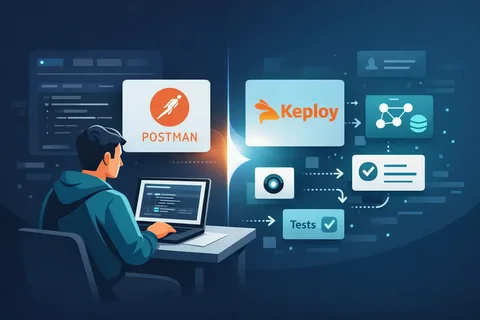
If you have utilized Postman for API testing, you are certainly not by yourself. It became the default choice for millions of software developers. It won them over because of its clean interface, easy request building, and highly shareable collections. However, engineering teams have grown significantly. Shipping cadences have accelerated to breakneck speeds. Consequently, a
This breakdown compares Keploy and Postman across the specific dimensions that matter to modern development teams. We will analyze test generation, the ongoing maintenance burden, continuous integration and continuous deployment (CI/CD) fit, and total time-to-coverage. The ultimate goal here is not to declare a definitive winner. Instead, we want to help you figure out exactly which tool fits your daily development workflow.
What Postman Does Exceptionally Well
Postman is genuinely excellent at what its creators designed it for. As an API design and team collaboration platform, it provides a highly effective shared workspace. Teams use this space to build request collections, write custom JavaScript test scripts, generate clean documentation, and run scheduled endpoint monitors. It works seamlessly with any HTTP-based API. Furthermore, it requires absolutely no installation beyond a standard desktop application. The learning curve is shallow enough that even non-developers can use it easily for basic API exploration.
Its companion Newman command-line interface (CLI) runner offers another major advantage. Because of Newman, you can plug Postman collections directly into a GitHub Actions or Jenkins pipeline without much friction. Postman remains a well-rounded choice for teams that need a highly visual API hub. It serves as a central point where product managers, quality assurance (QA) engineers, and backend developers collaborate around the exact same set of requests. It also doubles quite nicely as an API documentation tool. This dual functionality completely eliminates the need for a separate documentation software layer.
Where Postman Struggles with Scale
The real friction starts when teams try to use Postman as their primary regression testing layer for a fast-moving codebase. Every single test in a Postman collection is a test that someone had to write completely by hand. That means every new endpoint, every unexpected schema change, and every minor dependency update generates an immediate follow-up task. Someone must update the collection manually. On a small engineering team shipping a few pull requests (PRs) a week, this workload is manageable. On a larger enterprise team shipping twenty or fifty PRs a week, it becomes a genuine bottleneck.
There is also the persistent problem of non-deterministic data. Real-world APIs constantly return fresh timestamps, unique identifiers (UUIDs), and session tokens that change with every single response. Postman handles this dynamic behavior through custom JavaScript written in pre-request and post-request scripts. This approach requires specific scripting knowledge. It also adds a massive amount of long-term maintenance overhead.
Additionally, mock servers in Postman must be configured manually. This means engineers must stand up a parallel infrastructure of test databases, queue stubs, and fake external services before a single test can run reliably. The result is a frustrating pattern that many engineering teams recognize instantly. Every single feature commit is immediately followed by a “fix-tests” commit. The test suite quickly becomes a stressful liability rather than a helpful safety net. Eventually, engineers start routing entirely around it to save time.
How Keploy Approaches the Problem Differently
Keploy takes a fundamentally different architectural starting point. Rather than asking busy engineers to write test scripts manually, it captures them automatically from real API traffic. It achieves this by using an extended Berkeley Packet Filter (eBPF) agent that intercepts calls directly at the operating system kernel level.
You simply run your application once under Keploy’s record mode. From there, the tool generates comprehensive test cases from every single request your API handles. It captures the actual responses. At the same time, it automatically mocks downstream dependencies like databases, Redis caches, and external third-party services.
Because these tests come directly from real traffic, they cover the exact paths that production actually exercises. They do not just cover the simple happy paths that a developer remembered to write down. Keploy also handles non-deterministic fields automatically. It detects and normalizes things like timestamps and IDs during the replay phase. Because of this, tests do not fail on every single run just because a specific creation date field changed by a millisecond.
The practical effect is that a team can go from zero regression coverage to a full suite incredibly fast. It takes the same amount of time as running the application a single time. There is no complex test framework to configure, no mock server to stand up, and no annoying annotation layer to add to your codebase. The Keploy CLI integrates natively with any modern CI pipeline. Therefore, the generated tests run automatically on every PR without requiring additional tooling.
Head-to-Head: Generation, Mocking, and Maintenance
On the front of test generation, the gap between the two tools is significant. Postman requires a developer to manually create every single request, write individual assertions, and organize complex collections. Keploy generates tests automatically from captured traffic. It requires no manual scripting at all. For a team managing fifty distinct API endpoints, Postman represents fifty separate, manual authoring sessions. In stark contrast, Keploy represents a single recording run.
When it comes to mocking, Postman’s Mock Server feature is certainly useful, but it requires significant setup. You must define the mock responses manually. You also have to maintain them actively as the API evolves over time. Keploy captures all downstream dependency calls during the live recording session. It then auto-generates separate mock files for databases, caches, and external services. When you replay tests in your CI pipeline, Keploy substitutes those mocks transparently. This completely eliminates the need for a dedicated test database or a local instance of any third-party service.
Maintenance is another area where the experiences diverge. Both tools require some attention when APIs change, but the actual burden differs considerably. A Postman collection breaks silently. The test was hardcoded to expect a specific schema. When that schema changes, someone has to jump in and manually update the script. Keploy’s tests are simply regenerated from traffic. When application behavior changes, a new recording session updates the entire suite automatically. Teams that have measured this shift report reclaiming two to three engineering days per sprint. That is time that previously went entirely to tedious test maintenance.
Open Source and Pricing Dynamics
Keploy is fully open source under the Apache 2.0 license. It boasts a vibrant community with over 17,000 GitHub stars. The core functionality is completely free to use. Paid cloud and enterprise plans are available for larger teams that want managed infrastructure and advanced security.
Postman is proprietary software. It does offer a basic free tier that covers individual use, but its paid plans scale strictly per seat. This becomes expensive when unlocking team features like shared workspaces and private collections. For engineering teams with strict cost sensitivities or a strong preference for self-hosting their developer tools, Keploy’s open-source nature provides a meaningful advantage.
Choosing the Right Tool for Your Workflow
Postman remains the better fit when your primary need centers around API design, documentation, and collaboration across a diverse team. If you need a shared workspace where product managers can explore endpoints, QA engineers can build manual test cases, and developers can reference quick collection examples, Postman is incredibly hard to beat. It is also highly useful for ad-hoc API exploration. It makes perfect sense for teams that are already deeply invested in Postman collections and existing Newman pipelines.
Keploy is the clear winner when your primary need is automated regression coverage without the massive overhead of writing and maintaining tests. If your team ships code frequently and cannot afford the time to manually keep a test suite current, Keploy’s traffic-capture model removes that burden entirely. It is also an exceptionally strong choice for engineering teams migrating from a legacy monolith to modern microservices. Capturing traffic at the boundary and replaying it against new services provides a behavioral parity check that manual tests cannot easily replicate.
Can You Use Both Tools Together?
Yes, absolutely. In fact, many modern engineering teams do exactly that. Postman works beautifully as the exploration and documentation layer during the initial API design phase. It gives developers and external stakeholders a clean, visual interface to understand exactly what an endpoint does.
Keploy then takes over as the robust regression layer once the API is actively running. It generates tests from actual traffic patterns and runs them silently in CI on every single PR. The two tools operate at entirely different points in the software development lifecycle. Because of this, they complement each other rather than duplicating functionality.
This choice is part of a larger shift in how engineering teams think about test automation. The traditional model where developers write tests manually after writing code is fading. It is giving way to traffic-driven and AI-assisted approaches that generate coverage from real application behavior. For a broader look at where this industry is heading, you can explore this overview of AI testing tools transforming modern software testing. This resource covers the emerging tools and workflows that are worth understanding today.
Keploy fits squarely into this industry shift. Its eBPF-based capture approach is not just a simple wrapper around existing test frameworks. Instead, it is a completely different architectural model for how test suites get created and maintained. Whether that model is right for your engineering team depends entirely on where your current operational friction lies. However, for teams where manual test maintenance has become a severe bottleneck, making the switch represents a meaningful transformation in workflow, not just a simple tool swap.