
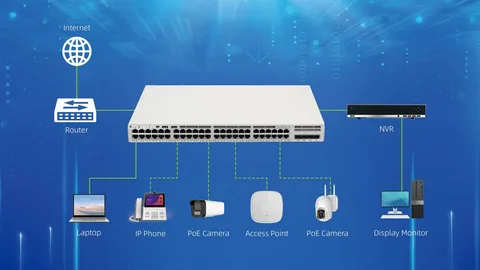
Smart buildings are transforming the way residential complexes, commercial offices, educational institutions, hospitals, hotels, warehouses, and industrial facilities operate. By integrating intelligent technologies such as IP surveillance, wireless access points, VoIP phones, access control systems, and environmental sensors, smart buildings improve efficiency, security, and energy management. At the center of many of these systems is
Smart buildings are transforming the way residential complexes, commercial offices, educational institutions, hospitals, hotels, warehouses, and industrial facilities operate. By integrating intelligent technologies such as IP surveillance, wireless access points, VoIP phones, access control systems, and environmental sensors, smart buildings improve efficiency, security, and energy management.
At the center of many of these systems is Power over Ethernet (POE) technology. Instead of requiring separate cables for power and data, POE delivers both through a single Ethernet cable. This simplifies installation, reduces infrastructure costs, and creates a cleaner, more organized network.
A well-designed poe switch plays a vital role in supporting connected devices while ensuring stable network communication and reliable power delivery. This guide explains how POE switches contribute to smart building infrastructure and outlines the best practices for selecting, installing, and maintaining them.
What Is Power over Ethernet?
Power over Ethernet (POE) is a networking technology that allows electrical power and data to travel through the same Ethernet cable.
Traditionally, network devices required one cable for data and another electrical connection for power. POE eliminates the need for separate power wiring, making installations faster and more efficient.
Today, POE technology is commonly used with:
- IP surveillance cameras
- Wireless access points
- VoIP telephones
- Access control systems
- Smart lighting controllers
- Network sensors
- Building automation devices
This approach creates a flexible and scalable infrastructure suitable for modern buildings.
Why Smart Buildings Depend on POE Technology
Smart buildings rely on numerous connected devices that communicate continuously with centralized management systems.
Using POE technology provides several important advantages:
- Simplified installation
- Reduced cable requirements
- Centralized power management
- Easier maintenance
- Greater installation flexibility
- Lower infrastructure complexity
These benefits make POE one of the most practical networking solutions for intelligent building environments.
The Role of a POE Switch
A poe switch functions as both a network switch and a power source. It distributes network connectivity while supplying electrical power to compatible devices over Ethernet cables.
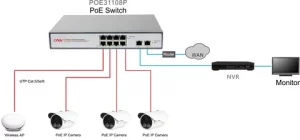
Instead of installing electrical outlets near every connected device, installers can connect cameras, wireless access points, or access control units directly to the switch.
This simplifies deployment while reducing installation time and improving cable organization.
Supporting Multiple Smart Building Systems
One of the greatest strengths of POE technology is its ability to support various building systems from a centralized network.
These systems may include:
- Surveillance cameras
- Smart door access
- Video intercom systems
- Wi-Fi infrastructure
- Digital signage
- Environmental monitoring
- Occupancy sensors
- Building management controllers
By powering multiple technologies through a single network, organizations can simplify both installation and maintenance.
Simplified Installation Process
One reason POE technology has become so popular is its straightforward installation process. Instead of coordinating electrical contractors and network installers separately, a single Ethernet cable often meets both power and communication requirements.
This approach offers several benefits:
- Faster deployment
- Reduced installation time
- Cleaner cable management
- Lower labor requirements
- Easier future modifications
These advantages are especially valuable during large construction or renovation projects.
Better Cable Management
Cable organization is essential in smart buildings where hundreds of connected devices may operate simultaneously.
Good cable management improves:
- Equipment accessibility
- Airflow around networking equipment
- Troubleshooting efficiency
- Maintenance procedures
- Overall appearance
Properly labeled and organized Ethernet cables make future upgrades significantly easier.
Power Budget Planning
Every connected device consumes electrical power. Before installing networking equipment, calculate the total power requirements of all devices.
Factors to evaluate include:
- Camera power consumption
- Wireless access points
- Door controllers
- Network phones
- Future expansion capacity
Leaving additional power capacity allows the infrastructure to support future growth without replacing existing equipment.
Scalability for Growing Buildings
Modern buildings rarely remain unchanged.
Businesses frequently expand by adding:
- Additional surveillance cameras
- New office spaces
- More wireless coverage
- Access control points
- Conference room equipment
- Smart environmental sensors
Selecting networking equipment that supports expansion helps avoid costly infrastructure upgrades later.
A reliable poe network switch provides the flexibility required to accommodate future building improvements while maintaining stable network performance.
Supporting High-Speed Data Transmission
As surveillance cameras and smart devices become more advanced, network traffic continues to increase. Higher-resolution video, cloud connectivity, and intelligent analytics require greater bandwidth.
A well-designed network should provide:
- Stable communication
- Low latency
- High-speed data transfer
- Reliable device connectivity
- Efficient traffic management
Choosing quality networking equipment helps maintain consistent system performance even as demand grows.
Energy Efficiency Benefits
Energy efficiency is an important consideration for modern smart buildings. POE technology contributes to improved energy management by allowing centralized control over connected devices.
Benefits include:
- Intelligent power management
- Scheduled device operation
- Reduced unnecessary energy usage
- Simplified power monitoring
Organizations can optimize energy consumption while maintaining continuous building operations.
Centralized Maintenance
One of the significant advantages of centralized networking equipment is simplified maintenance. Instead of inspecting individual power adapters throughout a building, administrators can manage connected devices from a central location.
Routine maintenance should include:
- Inspecting Ethernet cables
- Cleaning networking equipment
- Monitoring power consumption
- Reviewing network performance
- Updating firmware
- Verifying connected devices
Regular inspections improve reliability and reduce unexpected downtime.
Network Security Considerations
As smart buildings become increasingly connected, cybersecurity is equally important.
Protecting network infrastructure includes:
- Using strong administrator passwords
- Restricting unauthorized access
- Updating firmware regularly
- Separating building networks from guest networks
- Monitoring network activity
- Encrypting sensitive communications
Strong cybersecurity practices help protect connected building systems from unauthorized access.
Environmental Installation Considerations
Networking equipment should be installed in environments that promote reliable operation.
Avoid placing switches in areas exposed to:
- Excessive dust
- High humidity
- Direct sunlight
- Water leakage
- Poor ventilation
- Extreme temperatures
Clean, well-ventilated equipment rooms improve hardware lifespan and system stability.
Choosing the Right Networking Equipment
Every building has different infrastructure requirements.
When selecting networking equipment, consider:
- Number of available ports
- Total power budget
- Network speed
- Expansion capability
- Environmental suitability
- Reliability
- Warranty and manufacturer support
Choosing equipment based on long-term operational needs rather than immediate requirements often delivers better value.
A dependable powered ethernet switch helps maintain consistent power delivery while supporting stable communication across multiple building systems.
Common Installation Mistakes
Several avoidable mistakes can reduce network performance.
Common examples include:
- Ignoring total power requirements
- Overloading switch capacity
- Poor cable organization
- Using low-quality Ethernet cables
- Blocking ventilation openings
- Skipping firmware updates
- Failing to document network layouts
Avoiding these issues helps maintain reliable building operations.
Best Practices for Long-Term Performance
To maximize network reliability, follow these recommendations:
- Plan the infrastructure before installation.
- Label every network cable clearly.
- Leave additional power capacity for future devices.
- Install networking equipment in clean, ventilated locations.
- Inspect hardware regularly.
- Monitor power usage and network traffic.
- Keep firmware updated.
- Document all network connections for easier maintenance.
Following these best practices supports long-term stability while simplifying future upgrades.
Future of POE in Smart Buildings
The demand for intelligent buildings continues to grow as organizations adopt automation and connected technologies.
Future developments in POE infrastructure are expected to include:
- Higher power delivery capabilities
- Faster network speeds
- Improved remote management
- Enhanced energy efficiency
- Better integration with artificial intelligence
- Expanded support for smart building automation
These advancements will allow businesses to deploy more intelligent devices while maintaining efficient and scalable infrastructure.