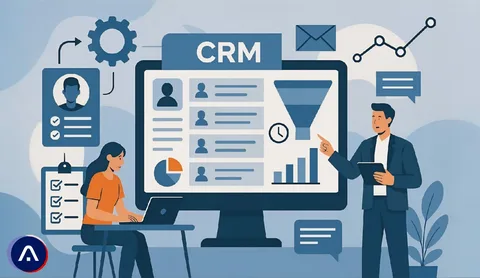
Most CRM problems don’t begin with customers. They begin internally. One team updates the deal stage. Another team works from an older report. Marketing sees one version of the customer. Sales sees another. Everyone is technically using the same CRM. But somehow, no one is seeing the same picture. The Strange Thing About Modern CRM
Most CRM problems don’t begin with customers.
They begin internally.
One team updates the deal stage.
Another team works from an older report.
Marketing sees one version of the customer.
Sales sees another.
Everyone is technically using the same CRM.
But somehow, no one is seeing the same picture.
The Strange Thing About Modern CRM Systems
At first, CRM software feels incredibly useful.
Everything becomes trackable.
Leads.
Deals.
Activities.
Customer interactions.
It creates structure where there was once chaos.
But as teams grow, something unexpected happens:
The CRM slowly turns into a place people update rather than a place people trust.
When Customer Data Stops Feeling Real-Time
This usually shows up in small moments.
A sales rep calls a lead that marketing already marked inactive.
Customer notes exist but inside another tool.
A deal progresses, but reporting updates later.
None of this feels catastrophic.
But over time, it creates friction between teams.
And friction changes behavior.
People stop relying on the system fully.
They start asking each other instead.
Why Collaboration Breaks Inside Traditional CRM Tools
Most CRM platforms were designed around record management.
Not around live collaboration.
That’s why growing companies often end up adding:
- Messaging tools
- Reporting systems
- Workflow apps
- Separate dashboards
Suddenly, customer information exists everywhere.
And instead of improving visibility, the system becomes fragmented.
Even strong sales pipeline management software starts feeling disconnected when teams work across too many tools.
The Difference Between Tracking Customers and Understanding Them
A lot of businesses think CRM is about storing customer data.
But real customer insight comes from context.
You need to know:
- What changed
- When it changed
- Who interacted with the customer
- What happened afterward
That only works when systems update in real time.
Otherwise, teams are always reacting to outdated information.
CRM Workflow Automation Isn’t Just About Saving Time
This is where things get misunderstood.
Most people hear CRM workflow automation and think:
“Less manual work.”
But the bigger advantage is consistency.
Automation ensures:
- Follow-ups happen on time
- Updates reflect instantly
- Teams stay aligned without constant communication
In fragmented systems, automation becomes complicated because workflows depend on multiple tools syncing together.
In connected systems, workflows move naturally.
The Shift Toward Customer Engagement Platforms
Modern businesses are starting to move away from isolated CRM thinking.
Instead of:
CRM → separate workflows → external reporting
They’re moving toward integrated customer engagement platforms where:
- Customer activity
- Team collaboration
- Automation
- Reporting
all exist in the same environment.
That changes how teams operate.
Why Real-Time Visibility Changes Sales Behavior
This part is interesting.
When teams trust the system:
- They stop asking for updates manually
- They move faster between stages
- Collaboration becomes natural
Not because people changed.
Because the system became reliable enough to support real-time decisions.
That’s what the best CRM software actually does.
Not just organize data.
But reduce hesitation.
Where Airtool Fits Into This New CRM Approach
Platforms like Airtool approach CRM differently than traditional standalone systems.
Instead of treating CRM as one isolated application, the focus is on building connected business workflows within the same platform.
If you explore how a
low code application development platform
supports CRM operations, the advantage becomes clear.
You’re not forcing separate systems to collaborate.
You’re creating workflows, customer management, automation, and reporting together from the beginning.
That means:
- Customer insights update instantly
- Teams work from the same information
- Automation happens without dependency delays
- Collaboration becomes easier across departments
And over time, the CRM becomes something teams rely on again not just something they maintain.
Why Scalability Matters in CRM Systems
CRM complexity grows quickly.
More leads.
lass=”yoast-text-mark” />>More sales reps.
More workflows. le=”font-weight: 400;”>
><span style=”font-weight: 400;”>More customer touchpoints.
A scalable CRM system must support:
- Real-time collaboration
- Flexible workflow automation
- Consistent customer visibility
Without becoming harder to manage.
That’s where modern enterprise software architecture becomes important.
Because scalability isn’t just about handling more records.
It’s about keeping teams aligned while the business grows.
Final Thoughts