It’s easy to underestimate small games. When something loads instantly in a browser, requires no installation, and asks you to press only one button, expectations are naturally low. You assume it will be forgettable. A distraction. Something you try once and immediately move on from. That assumption is exactly why doodle baseball feels so surprising.
It’s easy to underestimate small games.
When something loads instantly in a browser, requires no installation, and asks you to press only one button, expectations are naturally low. You assume it will be forgettable. A distraction. Something you try once and immediately move on from.
That assumption is exactly why doodle baseball feels so surprising.
What begins as a playful Google Doodle created for a holiday slowly reveals itself as a carefully crafted experience—one that understands timing, emotion, and the quiet joy of play better than many full-scale games.
The origin of Doodle Baseball and why it matters
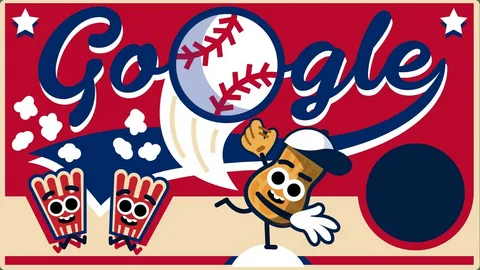
Doodle baseball was originally released as an interactive Google Doodle celebrating the Fourth of July. On the surface, it was meant to be light entertainment—a small tribute to baseball, summer, and American culture.
But Google’s Doodle team has always treated these mini-games as more than visual jokes. They are experiments in accessibility, creativity, and emotional design. Doodle baseball is one of the clearest examples of that philosophy working perfectly.
Because it was never intended to be a “main” game, it avoids the pressure of needing to impress. Instead, it focuses on delivering a single, polished idea extremely well.
A visual style that invites, not intimidates
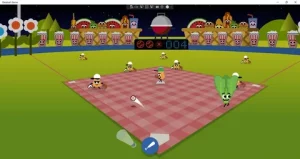
One of the first things you notice when playing doodle baseball is how friendly it looks.
The characters are not athletes. They’re food. Hot dogs hold bats. Peanuts fill the stands. Burgers, fries, and condiments react dramatically to every swing. This creative decision does something important: it immediately lowers emotional stakes.
You don’t feel judged and challenged. You feel welcome.
The animations are exaggerated but never overwhelming. Every reaction—whether it’s cheering, disappointment, or excitement—is clear and readable. Even if you’ve never watched a real baseball game, you instinctively understand what’s happening on screen.
That clarity is not accidental. It’s the result of intentional design that prioritizes approachability over realism.
Simple mechanics, surprisingly deep engagement
At its core, doodle baseball uses one mechanic: timing.
A pitch comes toward you. You click or tap to swing. That’s it.
There are no power-ups, no skill trees, no advanced controls. And yet, the game remains engaging far longer than expected. Why?
Because timing is a skill that feels endlessly improvable.
Early on, you miss constantly. You swing too early. Then too late. Then you hesitate. The game doesn’t explain why you failed—but the feedback is clear enough that you understand intuitively.
Eventually, you land a clean hit.
That moment feels disproportionately rewarding. Not because of points or progression, but because your brain recognizes improvement. You adjusted. You learned and you succeeded.
Doodle baseball taps into that feeling over and over again.
Personal gameplay experience: how it quietly pulls you in
When I first played doodle baseball, I told myself it would be a thirty-second distraction. I had something else to do. I wasn’t planning to stay.
The first few swings were bad. I laughed, missed again, and almost closed the tab. Then I connected with a pitch perfectly. The animation reacted instantly. The crowd celebrated. The ball flew across the screen.
I stayed.
What surprised me most was how relaxed the experience felt. There was no frustration when I failed. No tension when I succeeded. Just a smooth emotional rhythm: miss, adjust, hit, repeat.
Minutes passed without effort. I wasn’t chasing a leaderboard or an achievement. I was chasing a feeling—the satisfaction of clean timing.
That’s when it became clear that doodle baseball wasn’t just cute. It was carefully designed.
Why Doodle Baseball works for all ages
One of the reasons doodle baseball continues to be searched for and replayed is its universal appeal.
Children can enjoy it because it’s colorful, simple, and humorous. There’s nothing to read, no complex rules to memorize, and no punishment for mistakes.
Adults enjoy it for different reasons. It feels nostalgic without trying too hard. It reminds you of older games that respected your time and it offers a moment of play without demanding long-term commitment.
There are no ads interrupting gameplay. No monetization systems. No psychological tricks forcing retention. The game ends when you decide it ends.
That respect for the player is rare—and noticeable.
FAQ: Common questions about Doodle Baseball
How can you play Doodle Baseball today?
Doodle baseball is still available through Google’s official Doodle archive. It runs directly in modern web browsers and works on both desktop and mobile devices without downloads or accounts.
Is Doodle Baseball an official Google game?
Yes. Doodle baseball was created by Google’s Doodle team as an official interactive Doodle for the Fourth of July celebration.
Is Doodle Baseball safe for children?
Absolutely. Doodle baseball contains no advertisements, no in-game purchases, and no online interaction. It is fully family-friendly and appropriate for all ages.
Why Doodle Baseball still resonates today
In a gaming landscape filled with endless updates, live services, and attention-grabbing mechanics, doodle baseball feels refreshingly honest.
It doesn’t try to keep you forever.
Doesn’t pretend to be bigger than it is.
It simply delivers a few minutes of genuine enjoyment.
That restraint is its greatest strength.
Years after its release, people still return to doodle baseball not because it changes, but because it doesn’t need to. It provides a complete experience in a small space, and it leaves players feeling satisfied rather than drained.
If you’ve played doodle baseball before, you probably remember the sensation of that perfect swing more clearly than your final score. And if you haven’t, you may be surprised by how much a simple, one-button game can offer.