
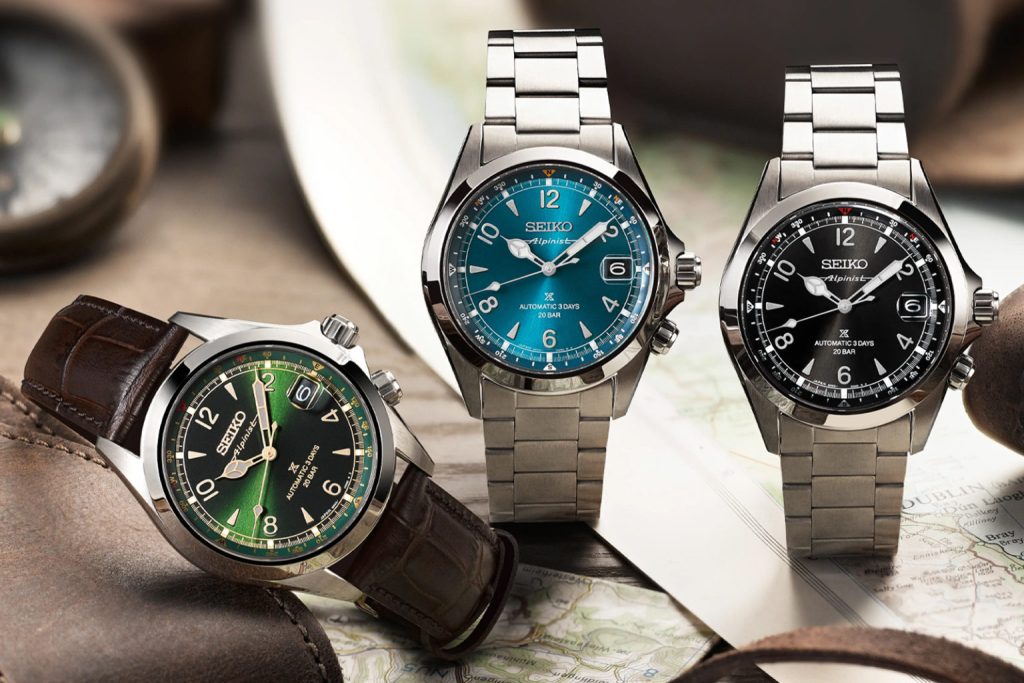
In horology, few names carry the widespread respect, technical weight, and global reach of Seiko. Founded in 1881 by Kintaro Hattori in Tokyo’s Ginza district, Seiko began as a modest shop for selling and repairing clocks. Today, it stands as a fully vertically integrated manufacturer—one of the few watchmakers on Earth that produces every component
In horology, few names carry the widespread respect, technical weight, and global reach of Seiko. Founded in 1881 by Kintaro Hattori in Tokyo’s Ginza district, Seiko began as a modest shop for selling and repairing clocks. Today, it stands as a fully vertically integrated manufacturer—one of the few watchmakers on Earth that produces every component of its timepieces in-house, from synthetic quartz crystals and mainspring alloys to microscopic gear trains.
Guided by Hattori’s foundational motto, “Always one step ahead of the rest,” a Seiko watch represents far more than a tool for keeping time. It is a bridge between historic Japanese artisanry and cutting-edge mechanical engineering.
Pivotal Moments in Watchmaking History
Seiko’s century-long journey is marked by ground-breaking innovations that reshaped the global watch industry:
-
1913 (The Laurel): Seiko produced the Laurel, Japan’s very first wrist-worn mechanical watch.
-
1965 (Japan’s First Diver’s Watch): Designed to withstand extreme conditions, this 150-meter diver laid the foundation for Seiko’s legendary sports watch lineup.
-
1969 (The Quartz Revolution): Seiko unveiled the Astron, the world’s first commercially available quartz wristwatch. By delivering unprecedented timekeeping accuracy, it changed the horological landscape forever.
-
1999 (Spring Drive Commercialization): Conceived by engineer Yoshikazu Akahane, Spring Drive combined a traditional mainspring with a quartz-regulated electromagnetic brake. The result was a movement offering one-second-a-day precision and a signature, perfectly fluid glide-motion seconds hand.
Three Engineering Pillars: Mechanical, Quartz, and Spring Drive
Unlike manufacturers that restrict themselves to a single technology, a Seiko watch can be driven by one of three distinct mechanical architectures:
Mechanical (Automatic & Manual Winding)
Powered purely by kinetic energy stored in a wound mainspring, Seiko’s mechanical movements range from the reliable 4R series (workhorses with 41-hour power reserves) to the elevated 6R series (offering 70-hour power reserves) and high-beat 8L/8R calibers assembled by hand. Inventions like the Magic Lever (1959) dramatically boosted self-winding efficiency.
Solar Quartz
Building on their 1969 breakthrough, modern Seiko quartz watches utilize integrated solar panels hidden beneath the dial. Light energy is converted into electrical power stored in a rechargeable battery, removing the need for frequent battery changes while delivering pinpoint accuracy.
Spring Drive
A true hybrid feat exclusive to the Seiko group, Spring Drive replaces the traditional mechanical escapement with the Tri-synchro Regulator. It uses mechanical force to generate electrical power, which then regulates a quartz crystal. The seconds hand moves in a continuous, dead-silent glide that reflects the smooth flow of time.
Core Collections: A Timepiece for Every Wrist
To help collectors navigate its vast catalog, Seiko groups its wristwatches into distinct series tailored to specific lifestyles
Why the Seiko Watch Remains a Collector Favorite
Whether you are buying your first $300 automatic wristwatch or adding an artisan-crafted dress watch to an established collection, Seiko holds a unique charm in the watch community for three key reasons:
-
Unrivaled Dial Artistry: In the Presage and Prospex LX tiers, Seiko offers dial finishes—ranging from multi-layered Urushi lacquer to intricate hemp-leaf (Asanoha) textures—that match timepieces costing three times as much.
-
Robust Reliability: Inventions like Diashock protection and Spron balance spring alloys ensure that Seiko mechanical movements can withstand decades of real-world wear.
-
Deep Cultural Identity: Every Seiko watch is subtly infused with Japanese design sensibilities—emphasizing the balance of light and shadow, organic textures, and clean geometry.
Final Thoughts
A Seiko watch is not merely a tool for tracking hours and minutes; it is a tangible piece of horological history. By combining a century of mechanical heritage with groundbreaking technological leaps like Quartz and Spring Drive, Seiko continues to prove that exceptional watchmaking can be accessible, beautiful, and enduring.