
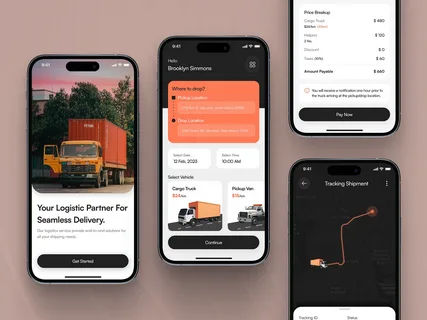
The rapid acceleration of digital transformation is fundamentally reshaping the logistics industry across the USA. Modern businesses now rely heavily on intelligent software ecosystems to manage fleets, optimize multi-stop routes, and run on-demand delivery services. Choosing an experienced development partner helps streamline daily operations, minimize unnecessary overhead, and significantly improve delivery accuracy. Because selecting the
The rapid acceleration of digital transformation is fundamentally reshaping the logistics industry across the USA. Modern businesses now rely heavily on intelligent software ecosystems to manage fleets, optimize multi-stop routes, and run on-demand delivery services. Choosing an experienced development partner helps streamline daily operations, minimize unnecessary overhead, and significantly improve delivery accuracy.
Because selecting the right technology partner requires a clear look at top industry players, here is a detailed breakdown of the leading logistics app development companies driving innovation.
Top Logistics App Development Companies in the USA
1. Apptunix – Driving Smart Logistics Innovation
Apptunix stands out as a high-authority leader in mobile-centric logistics and on-demand delivery software. The company specializes in creating high-performance, tailored mobile apps and robust backend ecosystems that resolve complex real-world operational bottlenecks. Their engineering teams integrate advanced modules like live asset monitoring via IoT, automated carrier dispatch, and AI-driven dynamic routing.
Apptunix balances intuitive user experience design with enterprise-grade system architecture. This makes them a premier, cost-effective partner for ambitious logistics startups requiring rapid MVP rollouts, as well as established enterprises seeking to maximize their long-term ROI.
2. RouteCore Technologies
RouteCore Technologies builds intelligent logistics applications designed primarily to improve route planning accuracy and dispatch efficiency. Their specialized solutions help transportation providers coordinate driver schedules, track high-value shipments in real time, and reduce overall fuel consumption. They offer an excellent fit for small to mid-sized shipping businesses requiring practical, reliable, and straightforward logistics software development services.
3. FleetWay Systems
FleetWay Systems focuses its engineering efforts on building robust fleet management applications backed by powerful, resilient database structures. Their software applications support real-time vehicle telematics, driver behavioral monitoring, and instant delivery status updates. This company provides an ideal choice for businesses seeking straightforward, easy-to-manage solutions to oversee their asset utilization.

4. TransLogic Labs
TransLogic Labs specializes in tailoring transportation and logistics software specifically for mid-market courier networks and large distribution companies. Their mobile and web applications handle end-to-end order management, dispatch automation workflows, and automated billing reporting tools. These comprehensive systems help regional distributors maintain fluid, uninterrupted daily operations.
5. CargoSoft Solutions
CargoSoft Solutions delivers highly flexible, cloud-based logistics platforms engineered to support modern warehouse management, end-to-end shipment visibility, and predictive supply chain analytics. Their development approach centers around software modularity and elastic cloud architecture. This specific design focus makes their software ecosystems highly suitable for growing, asset-heavy logistics enterprises.
6. MoveSmart Tech
MoveSmart Tech creates clean, efficient, and lightweight on-demand logistics application development solutions. Their mobile products serve local delivery startups and hyperlocal courier networks exceptionally well by offering essential functionalities—like live customer tracking, instant push notifications, and simplified driver dashboards—without burying users under unnecessary technical complexity.
Why Custom Logistics Software Outperforms Off-the-Shelf Options
Investing in custom logistics app development allows businesses to build tailored solutions matching their unique transportation, handling, and delivery workflows. Custom software provides distinct competitive advantages over prepackaged SaaS platforms:
-
Eliminates Third-Party Dependencies: Custom applications reduce your reliance on restrictive third-party software subscriptions, lowering your recurring operational costs over time.
-
Enhances Data Security: Proprietary platforms give you complete control over your operational metrics and customer shipping data, which minimizes vulnerability risks.
-
Provides Absolute Scalability: Tailored software architectures easily adapt to changing marketplace regulations, sudden volume spikes, and seasonal demands.
Essential Features Checklist for Logistics Applications
A reliable logistics software development company must deliver a cohesive system comprising distinct user roles and interconnected dashboards:
| User Interface | Core Essential Features | Primary Operational Value |
| Driver Mobile App | GPS routing, digital proof of delivery (e-signatures), instant dispatch alerts, offline mode. | Maximizes on-road driver efficiency and reduces manual paperwork. |
| Customer Portal | Live map shipment tracking, accurate ETA notifications, transparent payment gateways. | Lowers customer support volume and elevates brand trust. |
| Admin Control Tower | Automated dispatch logic, multi-stop route optimization, real-time vehicle telematics. | Lowers total fuel consumption and ensures full fleet compliance. |
| Enterprise Backend | Predictive analytics, native ERP/CRM integrations, scalable cloud databases. | Delivers actionable data insights to streamline future growth. |
Future Tech Trends Shaping Logistics Software
The future of logistics management software hinges on integrating advanced, data-rich technologies that eliminate manual bottlenecks:
AI-Driven Route Optimization: Machine learning algorithms continuously analyze historic traffic patterns, current weather conditions, and vehicle weights to calculate the absolute most fuel-efficient route in fractions of a second.
-
IoT-Enabled Cold Chain Monitoring: IoT sensor networks embedded inside cargo containers continuously stream temperature, humidity, and vibration telemetry directly to the cloud, protecting perishable shipments from spoiling.
-
Blockchain-Powered Transparency: Decentralized ledgers create immutable, tamper-proof audit trails for cross-border shipping documents, freight bills, and chain-of-custody handoffs.
FAQs – Logistics Software Development in the USA
What is the concrete difference between a logistics app and logistics software?
Logistics app development focuses primarily on the mobile-first front-end interfaces utilized directly by delivery drivers, warehouse floor workers, and end customers. Conversely, logistics software development encompasses the broader digital ecosystem. This includes back-end databases, cloud servers, enterprise admin panels, and API integrations that handle deep operational data processing.
How long does it typically take to build an enterprise-ready logistics platform?
A basic on-demand logistics Minimum Viable Product (MVP) featuring standard tracking can be successfully deployed within 3 to 4 months. However, a fully customized, enterprise-grade fleet management system or warehouse management platform requiring deep legacy ERP system integrations typically takes 6 to 12+ months of continuous engineering.
Can custom logistics software integrate smoothly with my existing ERP or CRM platforms?
Yes. Professional logistics developers prioritize building robust, custom API layers that create a flawless bridge between your new mobile logistics apps and your legacy enterprise systems (such as SAP, Oracle, Salesforce, or Microsoft Dynamics). This ensures uninterrupted data flow across your entire company.