In Drift Hunters, building the perfect drift setup is just as important as mastering driving skills. A well-tuned car allows you to control slides more easily, maintain longer drift chains, and adapt to different track layouts. Instead of relying only on raw power, the key to success lies in finding the right balance between speed,
In Drift Hunters, building the perfect drift setup is just as important as mastering driving skills. A well-tuned car allows you to control slides more easily, maintain longer drift chains, and adapt to different track layouts. Instead of relying only on raw power, the key to success lies in finding the right balance between speed, stability, and responsiveness.
Understanding drift setup fundamentals
A drift setup is a combination of upgrades and adjustments that determine how your car behaves on the track. The goal is to create a setup that allows smooth drift initiation, stable control during slides, and easy transitions between corners.
Many players assume that increasing all stats to maximum will produce the best results, but this often leads to poor handling. A proper setup focuses on balance rather than extremes.
Choosing a suitable car for tuning
Before making adjustments, it is important to start with a car that fits your skill level. Balanced cars are usually easier to tune because they provide a stable foundation. High-powered cars can achieve impressive drifts, but they may require more precise control.
Selecting a car that feels comfortable to drive will make it easier to fine-tune your setup and improve overall performance.
Understanding how scoring works
To consistently achieve high scores, it is important to understand how the scoring system functions. Points are awarded based on drift angle, speed, and how long you can maintain a continuous drift. The longer your drift chain lasts, the higher your multiplier becomes.
Breaking your drift, hitting a wall, or losing control will reset your combo, which can significantly reduce your total score. This is why maintaining smooth and stable drifts is more valuable than attempting risky moves.
Setting the right power level
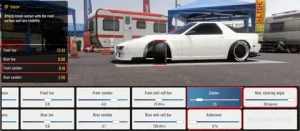
Power plays a major role in drifting. Increasing turbo or engine performance helps maintain speed during long drifts and allows for wider drift angles. However, too much power can make the car unstable and difficult to control.
A good strategy is to gradually increase power and test how the car responds. If the car begins to spin out frequently, reducing power slightly can improve stability. The ideal setup provides enough speed to sustain drifts without sacrificing control.
Improving braking control
Brakes are essential for setting up drifts. Strong braking allows you to slow down before entering corners and position the car correctly. This makes it easier to initiate a smooth drift.
However, braking should be controlled and consistent. Sudden or excessive braking can interrupt your drift flow. Learning to brake smoothly before turns is just as important as adjusting the brake settings themselves.
Adjusting weight and balance
Weight reduction can improve how responsive your car feels. A lighter car reacts faster to steering inputs, which is useful when making small corrections during a drift.
At the same time, extremely light setups can feel overly sensitive. Finding a balance where the car feels responsive but still stable is important for maintaining control throughout long drift chains.
Managing throttle and steering response
Even with a perfect setup, poor control can ruin a drift. Smooth throttle application helps maintain a consistent Drift Hunters angle, while gentle steering inputs keep the car balanced.
If your setup feels too aggressive, try reducing throttle input during drifts. If the car feels slow to respond, focus on more precise steering adjustments. The goal is to match your driving inputs with the behavior of your tuned car.
Testing and refining your setup
No setup is perfect on the first attempt. Testing your car on different tracks is essential for understanding how it performs in various situations. Wide tracks are useful for practicing long drifts, while tighter tracks help test control and precision.
After each test, make small adjustments rather than large changes. Gradual tuning allows you to identify what works best and avoid creating new handling problems.
Adapting to different track conditions
Some setups perform better on specific types of tracks. For example, a high-power setup may work well on open tracks with long corners, while a more controlled setup may be better for technical tracks with tight turns.
Learning to adjust your setup based on the track can give you an advantage and help you maintain consistent performance across different environments.
Common setup mistakes
One of the most common mistakes is focusing only on speed and ignoring control. Another mistake is making large adjustments without testing, which can lead to unpredictable handling.
Avoid rushing the tuning process. Taking time to understand how each change affects your car will lead to better results.
Conclusion
Creating the perfect drift setup in Drift Hunters is a process that requires patience and experimentation. By balancing power, braking, and handling, you can build a car that is both stable and capable of high-scoring drifts.
With the right setup and consistent practice, you will gain better control, extend your drift combos, and improve your overall performance on every track.
In Drift Hunters, achieving insane drifts and high scores is all about precision, control, and consistency. The game rewards players who can maintain long drift chains, manage speed effectively, and adapt to different track layouts. While flashy drifting may look impressive, the real key to high scores lies in technique and smart gameplay.